Rail pad functions are often reduced to one word: cushioning. In reality, a rail pad is a precision engineered component that controls load, vibration, insulation and wear at the rail seat.
On crane runways and heavy industrial track, the rail pad sits between the rail base and the sole plate or foundation. It decides how wheel load flows into the structure.
This article focuses on rubber rail pads for crane and industrial track. It covers the 7 critical rail pad functions, the engineering behind vibration damping, and how to specify the right pad for port and mine duty.
1. Rail Pad Functions: Load Distribution Across the Rail Base
A steel rail concentrates wheel load into a narrow base. Without a pad, that pressure concentrates at high spots and edge contacts.
The rail pad spreads load evenly across the full rail base width, lowering peak contact pressure on the sole plate and concrete.
Even distribution reduces local crushing, cracks and settlement under repeated wheel passes.
2. Rail Pad Functions: Vibration Damping and Shock Absorption
Every wheel pass sends a dynamic pulse into the track. The pad absorbs part of that energy and converts it into low-grade heat through internal material damping.
This lowers the dynamic force transmitted into the rail clips, sole plates and foundation.
Steel-reinforced rubber pads keep this damping effect stable, because the steel insert prevents the rubber from extruding sideways under heavy load.
ForgeSail field experience on heavy port duty shows 40–50% reduction in track-borne vibration amplitude at key frequency ranges, where grooved, steel-reinforced pads replace direct steel-to-steel contact. Actual performance varies with wheel load, wheel diameter and foundation stiffness. Reduced vibration also helps extend the service life of the rail, sole plate and foundation.

3. Rail Pad Functions: Noise Reduction on Crane Runways
Vibration and structure-borne noise travel together. By damping vibration at the rail seat, the pad also cuts radiated noise.
This matters for indoor cranes, workshops and urban yards where noise limits apply.
A pad cannot replace correct wheel-rail geometry, but it removes the high-frequency rattle that comes from loose or hard rail seats.
4. Rail Pad Functions: Electrical Insulation and Corrosion Separation
Rubber pads electrically isolate the rail from the supporting structure. They increase contact resistance to limit stray currents in signalled track and in crane systems with live conductors.
The pad also breaks the direct metal-to-metal contact between the rail base and the sole plate. This prevents water and contaminants from being trapped at the interface, reducing crevice corrosion, and removes a conductive path that can drive stray-current corrosion.
Where stray current or electrolytic corrosion is a risk, pad insulation is a design requirement, not an option.
5. Rail Pad Functions: Rail Base and Foundation Protection
Small relative movement between rail and support causes fretting and abrasion. Over years, this wears the rail base and the sole plate top surface.
The rail pad acts as a wear interface. It wears before the rail or foundation does, and it is far cheaper to replace.
This protection extends the service life of the rail, the sole plate and the grouted foundation.
6. Rail Pad Functions: Maintaining Clip Pretension
Rail clips hold the rail through a clamping force. If the rail seat compresses or wears, that force drops and the rail loosens.
A pad with controlled stiffness keeps the clip at its design deflection. It maintains constant toe load through temperature change and dynamic load.
Pads that are too soft allow movement and clip fatigue. Pads that are too hard lose the damping benefit. The correct stiffness is a balance.
As an indicator, damping-grade pads often fall in the 20–60 kN/mm vertical static stiffness range, while high-stability pads for heavy crane rails can exceed 100 kN/mm. Exact values depend on pad design and load — always confirm with the manufacturer’s datasheet.
Note: stiffness values are load-dependent for elastomeric pads, and static stiffness differs from dynamic stiffness under cyclic crane wheel loading.

7. Rail Pad Functions: Environmental Resistance in Ports and Mines
Port and mine environments combine salt air, oil, dust, UV and temperature swings. A basic rubber pad degrades quickly in these conditions.
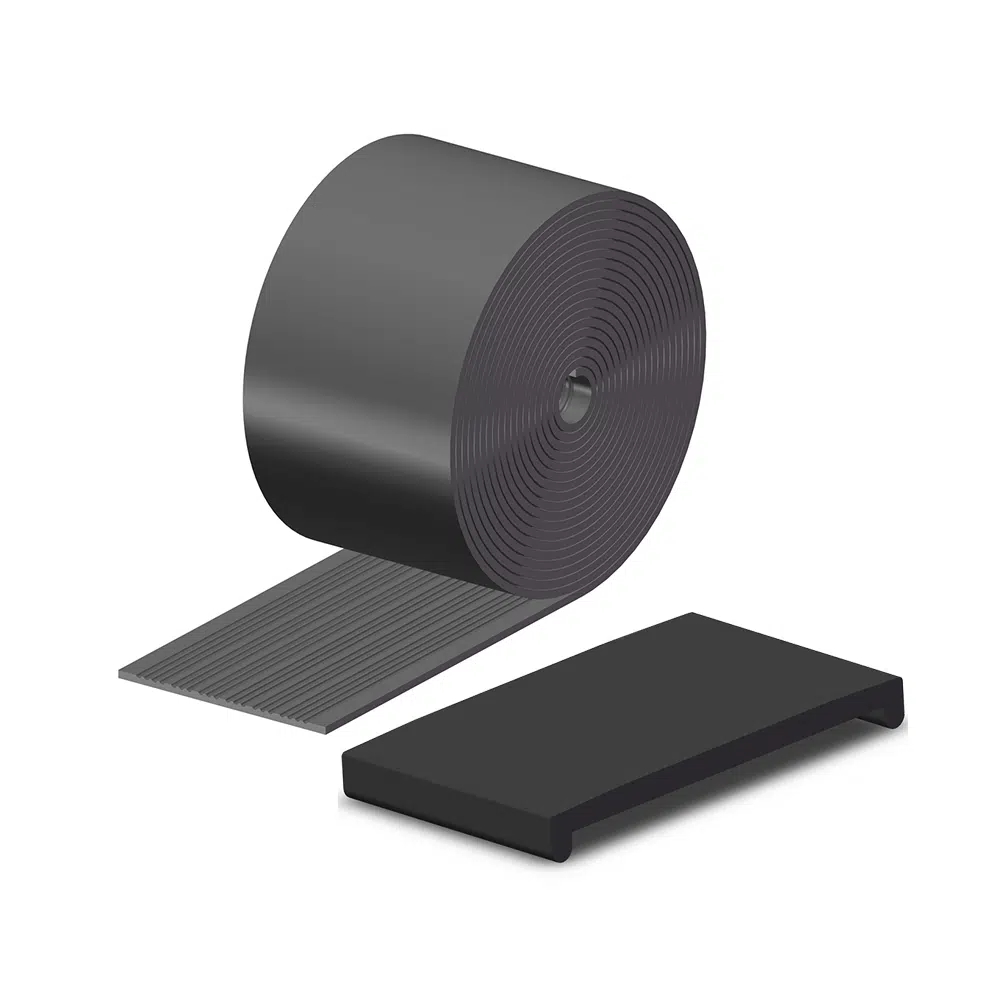
ForgeSail rail pads are available in two material options — SBR and NBR — both vulcanized to an internal steel strip. SBR offers better weathering and ozone resistance and suits general outdoor duty. NBR is selected for superior oil and grease resistance in contaminated port and mine environments. Confirm the exact grade for your site conditions against the product datasheet.
A grooved top surface improves load distribution and drains contamination away from the rail seat.
Typical rated service temperature depends on compound: SBR formulations can reach −30°C to +80°C, while NBR grades tolerate oil and higher heat at approximately −25°C to +100°C. Confirm the exact rating against your site conditions and the product datasheet.
ForgeSail Rail Pad Specification Overview
The table below summarises the key parameters to check when selecting a rail pad. Values are typical; always confirm against the product datasheet.
| Parameter | Typical value | Why it matters |
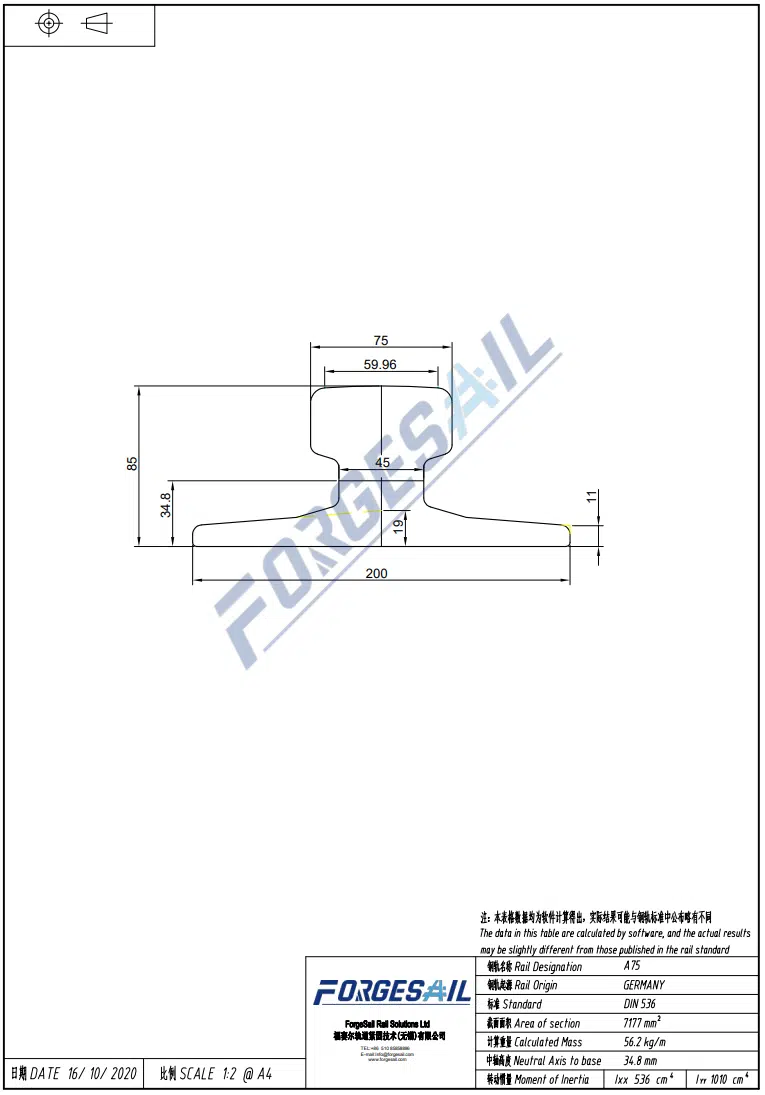
| Base width coverage | 110 mm to 220 mm+ (DIN / QU / AREMA) | Must match the rail base width of DIN A-series, QU and AREMA crane rails |
| Thickness | 5–12 mm (duty dependent) | Controls deflection and damping |
| Reinforcement | Internal steel strip | Limits lateral extrusion under load |
| Material | SBR or NBR (two options) | NBR for oil and heat; SBR for general duty |
| Service temperature | SBR: −30 to +80°C; NBR: −25 to +100°C | Confirm for the actual climate |
Conclusion
Rail pad functions cover load distribution, vibration damping, noise control, electrical insulation, wear protection and clip pretension.
Getting these functions right depends on pad stiffness, thickness, material and reinforcement. A pad that is too soft or too hard will fail in service.
ForgeSail supplies steel-reinforced SBR and NBR rail pads for crane runways, ports and mines, matched to DIN, QU and AREMA rail bases. Contact our engineering team for a rail pad selection review.